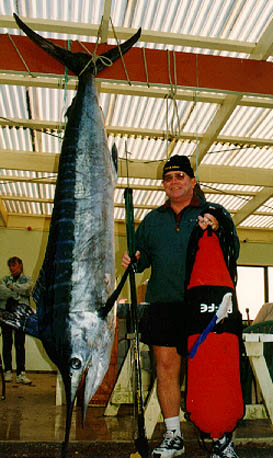
World Records for Striped Marlin
David Mullins
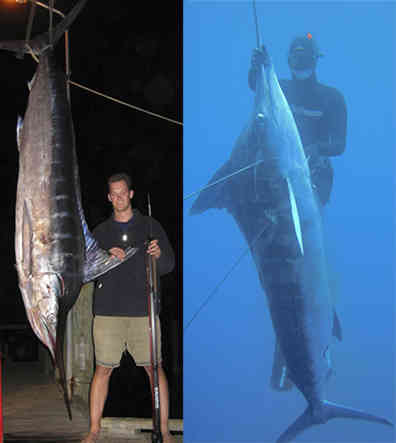
World-record Striped Marlin for men—156.6 kilograms
(344.9-pounds) by David Mullins
On the 7th of April, myself and 5 other spearos departed from Mangonui
onboard the 54ft Cascade on a 5 day trip to the Three Kings Islands, organized and guided
by the Wild Blue spearfishing club. Cascade was skippered by Charlie Care, and the
deckhand was Mike Tepou. After spending the first day diving the Cavalli Islands we
steamed overnight to the Three Kings, 64km Northwest of Cape Reinga, arriving at about 4
in the morning. Our intentions on this trip were to target marlin almost exclusively,
either on the King bank or more remote Middlesex bank, by trolling hookless lures to tease
them to the surface. We had been forced by the weather to spend the previous day hugging
the East coast, and those who were not still violently seasick from the rough trip were
eager to head out to the clear blue water and big gamefish of the King Bank. First,
however; it was decided to spend a more sedate morning diving around the boat in Southeast
Bay, one of the few places at the Kings that offered shelter from the strong Westerly
winds.
I entered the water at about 9am. It was cold and clear in the bay, with a visibility
of 20-25 meters. The flat bottom sloped gradually from 60 feet down, scattered with
boulders and patches of weed that held tarakihi, porae, pink maomao and at least one very
tame black spotted groper. A trio of kingfish was patrolling the bay, first circling
tightly to check me out and then keeping their distance, passing back and forth as I
headed out to a point at the Southern end of the bay. Although the largest was a decent
fish, somewhere between 20 and 25 kilos, we had not come to the Kings to shoot anything
other than trophy fish of 35 kilos and over.
Although I had brought a big Bluewater gun complete with slip-tip, breakaway rig and an
intimidating amount of recoil, for this dive I took only a 120 cm euro gun, custom made by
Wild Blue with a 6.5 mm shaft, 21 mm Picasso rubbers, a double wrap of 400lb mono and a
carbon fibre barrel. My bungee and Rob Allen floats remained on Cascade with the big gun;
to avoid the drag of multiple floats and the hassle of a sinking bungee I opted for my
standard setup which consisted of 27m of hard line and an 11 litre plastic Ronstat float.
On this dive I only expected to shoot golden snapper and tarakihi, or perhaps a big
kingfish if one showed up. Aside from bent spears, I had never found this rig to be
inadequate for even large kingfish.
As I neared the point it became evident that some current was running. Although the
bottom became more barren, around the rocks that jutted out into the sea schools of
baitfish and pink maomao indicated there might be some action on the up-current side of
the point. In the distance I could see the rock wall dropping vertically to the bottom of
80 feet. A school of large koheru swam past below me, disordered and moving fast.
Expecting to see a school of kingfish in pursuit I made a dive, waiting motionless in
mid-water. I waited without seeing anything till the last of the koheru had passed and
then returned to the surface. As I lay breathing for another dive, I looked down to see a
bill waving from side to side about 10 feet below me. In a couple of seconds the rest of
the big striped marlin came into view as it rose from behind me to check me out. Although
brightly lit up, the marlin was swimming slowly and as it passed underneath me it began to
sink back down. I made a shallow dive over the top of it, moving very slowly so as not to
spook the giant fish which was already almost out of range. Picking a spot just behind the
gill plates I took a shot, hoping to hit the spine or the back of the brain. However, the
size of the fish must have led me to underestimate the distance as my shaft connected low
in the shoulder. The marlin continued to swim off slowly, then came to a halt and rose
vertically to the surface where it stayed, head out of the water and shaking slightly for
several seconds. Thinking that I had stoned it I swam forwards, then backed off again as
it righted itself and moved off towards open water.
*********************************************
Chris Brown
Previous World Record:
The story of Chris Brown's striped marlin—134.40 kilograms (296.3 pounds)—A
New Zealand first and a world record claim. Story from Australian FreeDiving and
Spearfishing News, Issue No. 13, August 1997.
It has been a very successful season for veteran spearo Chris Browne from New Zealand.
53 year old Chris had only just returned from the Australian Bluewater, Freediving Classic
where he won the Masters section, when he speared New Zealand's first striped marlin.
Following is Chris' description of the catch that was sent to the International Bluewater
Spearfishing Records Committee, based in the USA.
Saturday, 19th April, 1997. Far North Spearfishing Championships briefing venue -
Tropicana Motor Camp, Whangarei. Diving Zone: Hen and Chicken Islands, off the coast of
Whangarei.
Tara Rocks on the Hen and Chicken Islands. The sea was a one and a half to two meter
nor'westerly swell, with large areas of whitecaps. My son, Steven Browne, was my buddy for
the day. I was driving my own Lazercraft 5.6 meters aluminum boat, powered by a 135hp
Mariner outboard.
This particular competition was being run under New Zealand Underwater rules, and was
therefore a swim competition. The boats all arrived at a designated area and were
anchored. No boats were to be used in the competition, except for those of the safety
officials. In these 6 hour swim competitions, the divers swim from the start/finish area
and must return to this area with their catch. Boats are not allowed to collect the catch.
The competition started at 9 am. A stiff current was running as we headed for the
southern side of Tara Rocks. In these competitions, we are allowed one gun each, mask,
snorkel, weightbelt, dive suit, float and line. The gun must only be powered by muscle
power and no scuba gear is allowed. You and your buddy line is attached to the main down
line float. Only one diver of the pair is allowed to dive at a time. Steve had just come
up after shooting a kahawhai and I was about to dive down to shoot a porae, which I had
seen, when I spotted the marlin. I dived down to have a look and at that moment, he turned
and I fired.
The shaft went through 22 mm below the lateral line on the star board side and came out
about 100 mm behind the port pectoral fin. I came to surface to tell my son I had shot a
marlin and I think I got the world 'Steve!' out and I was off. I played the fish for about
one and a half hours, at speeds I estimate to be about 8 to 10 knots.
I was a little concerned at times because out from the Hen and Chicken Islands is
virtually the ocean. I found, because of the angle of the shaft in the fish, I could
actually turn the fish in a very wide circle. I estimate that the distance over which I
was towed was approximately 4 kms. Eventually the fish tired and went to the bottom at
about 18 meters. I dived down and grabbed his bill and placed a rock in his mouth, and he
died within about a minute and a half. My dive knife had too small a blade to use.
Eventually I managed to aquaplane him to the surface, where he became negatively
buoyant. I then swam about 500 meters to rest on a rock until the safety patrol boat
spotted me. I loaded the fish into the boat. We then returned to the official start/finish
area. We waited until the end of the competition at 3 p.m. before heading back into the
boat ramp. I initially took the marlin to our competition weigh station, where we hoisted
it to get photographs. We then headed out to the Whangarei Deep Sea Anglers Club, based at
Tutukaka. This club is an internationally recognized weigh station for having fish
accurately weighed and recorded. My marlin weighed in at 134.4 kg (295.68 pounds). I was
issued with an official weight certificate by the weighmaster.
This is the first time a marlin has been speared in New Zealand waters. Apart from the
fact that I think my arms may be about two feet longer, I suffered no ill effects from my
efforts. Interestingly enough, the guys at the Whangarei Deep Sea Anglers Club said we
would have lost about 20 kg in the playing and landing of the fish.
*********************************************
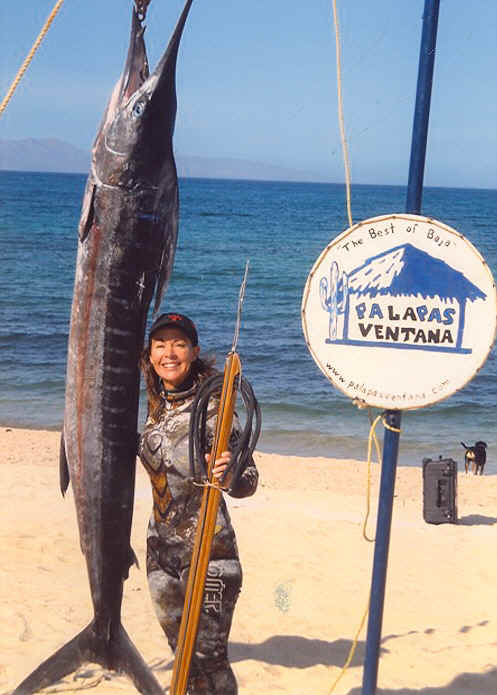
| World-record Striped Marlin for
Women—57.1 kilograms (126-pounds) by Colleen Gallagher. Taken July 15, 2010 at
Cerralvo Island, Baja California, Mexico.
The date is July 15,2010. I was diving with my two friends, Matt Davidson of Blue Tuna
Spearfishing and Max Mirinov, a fellow spearfisherman and photographer. We were on the
dive boat, Pez Sapo with our Captain Nono. We were diving at Ceralvo Island, Baja Mexico.
We were with Palapas Ventana Dive resort in La Ventana Mexico. The time was shortly after
noon, the weather was sunny and calm, 100 degrees temp outside and the water temp was a
warm 79 degrees.
Matt and Max and I had made repetitive dives for Wahoo, but even with multiple sightings,
they stayed just out of reach. We were all using Andre 144, 3 band spearguns, 57". My
Andre Euro144 was connected to a breakaway to a 75 foot Riffe float line that was clipped
to a Rob Allen 11 litre hard float. We were all using flashers, tossing them out in front
of ourselves by about 10 ft and allowing them to slowly drift down to 20 ft, flickering
off the sunlight as they descended, then we would dive down to retrieve them.
On this particular dive, this was my last day of diving and the guys were frustrated so
they got back in the boat. I made another dive and I was only 20 ft from the boat. Right
then, as I was just maybe 10 feet below the surface,just at 15 feet in came the largest
pelagic I had ever seen, a Striped Marlin. My Andre 144 was comfortably poised in my arm
to shoot, and I was amazed at how close it was, no more than 10-15 feet from the tip of my
gun. I placed a perfect downward shot right at the spine just behind the gill plate. The
slip tip buried deep into the meat of the spine, never toggled out of the body and the
Marlin initially was stunned. It was long enough time for Matt and Max who were looking
over the edge of the boat at all the commotion, to have the clear conscious to recognize
the enormity of it all and toss me a second Riffe float with a bungee and I clipped it
onto the back of my Rob Allen float, then Max passed me an unloaded Andre 144 mid handle 3
band speargun with 50 ft float line that I clipped to the Riffe float.
These two men kept the boat right next to me and kept me focused on what I had to do. This
was my Marlin, and they knew I had to do this on my own. The Marlin rallied and pulled the
first buoy down as it dragged me forward in the water. The Marlin never turned or jumped
or made any attempt at me, just propelled itself forward till it finally started to tire.
I moved from the back of the Riffe float, pulled myself and my 2nd speargun that was
clipped to the Riffe float forward to the first buoy, the Rob Allen which was now back on
the surface. I clipped it to the Rob Allen, and now started to pull in this enormous fish.
I closed the gap between myself and the Marlin, and clipping the float line off,
bringing it in little by little. When it was just 20 ft below me, I looked down at this
enormous animal and yelled to Matt, " I can't do this" He yelled back, "Yes
you can and go do it!"
I loaded the Andre 144 mid handle, took a breath and dove down next to the Marlin and
placed a second shot right at the gills, the blood started to pour out and as I ascended
to the surface, it now had two shafts in it and it was twitching. I yelled to Matt to give
me a third gun, and he passed me an unloaded 144 Euro Andre 3 band gun with a 50 ft float
line, that I quickly loaded and then I took a breathe, made a short descent to a little
over 20 ft down into the ocean,and placed the third shot in the head of the Marlin. It was
over, it was motionless.
I then pulled the Marlin up to the surface, all by myself, getting tangled and untangled
in the three float lines, two buoys and presented the 126lb marlin to the Boat Captain
with three shafts pierced in its body.
It was an incredible experience for me.
I brought the Marlin by boat onto the beach at Palapas Ventana and it weighed in on a
certified IUSA scale at 126 lbs and 109" in length. |
|
|