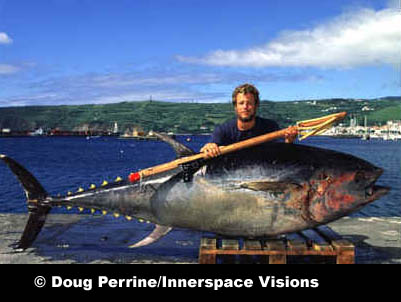
In the Azores on August 19, 1997, Paulo Gaspar claimed the Atlantic
bluefin record-297.2 kilograms (655 pounds). This is a phenomenal catch. Besides its size,
what makes this record special is the character and preparation of Paulo himself-a
consummate bluewater hunter.
Gaspar was born and raised in the Azores. He enjoyed all water sports, but his passion has
always been diving and spearfishing. "Big fish always fascinated me and became an
obsession," he recalls. "As the years went by, I began to acquire the utmost
respect for the sea, and all its existence, and I adopted the attitude of a selective
hunter. The risk of being attacked by a swordfish, a bluefin tuna or even a shark sparked
in me a sense of adventure."
Paulo learned from the local fishermen that the bluefin had come closer to shore and in
greater numbers than anytime in 20 to 30 years. However, the fishermen cautioned Paulo
that his attempt to land a giant bluefin would end in disaster. They told him of a fellow
fisherman who got tangled in his fishing line. The huge tuna towed him 24 meters deep
before fellow fishermen arrested his descent and pulled him and the tuna to the surface.
Tragically, in the excitement, someone cut the wrong end of the line and the tuna towed
the man into oblivion.
Undaunted, Gaspar never stopped thinking about capturing a giant bluefin. He became
obsessed whenever he sighted bluefin underwater. He slept fitfully, ate little and spent
little time with his family.
Two more tuna encounters brought him to fever pitch. With an inadequate reef gun, Paulo
launched his spear at the back of a giant as it disappeared at "supersonic"
speeds. Line ripped through Paulo's hands, but in a few minutes, the fish was free,
leaving Paulo with a spear bent 90 degrees and a fractured spearhead. "I learned from
this experience that I had the wrong equipment," he remembers. "I was trying to
shoot an elephant with a BB gun." While waiting for an adequate bluewater speargun,
Paulo had another significant tuna encounter.
Still carrying his 130-centimeter speargun, Gaspar fired once more at a large tuna-this
time in self defense.
Even today, when I think about this, I get chills. I had been in the water for at least
two hours when I spotted a bluefin about 12 meters away and about 2 meters deep. Its side
was toward me and it swam slowly. I stayed completely still admiring this beautiful fish.
I was totally impressed with its size and the grace with which it swam.
Suddenly, the fish turned toward me, swimming very fast. Realizing the danger, I aimed my
gun. When I pulled the trigger, I knew I wasn't going to capture or kill it. In spite of
its speed on a collision course with me, it wasn't at proper range for a kill. However, my
intentions were only to divert it. I knew it wanted to bump me.
The fish leaped out of the water and almost came down on top of me. When I think of this,
one vivid image stands out: the face of the bluefin so big and so close with a large
opened mouth and lots of line (almost like spaghetti) floating all around in the violently
disturbed waters.
The day finally came when Gaspar received his Riffe gun equipped with three bands and a
shaft with a detachable spearhead. The same day he took his untested gun into the waters
400 meters deep off Silveira Island.
It was 4 p.m. when I arrived in my 18-foot Boston Whaler. I couldn't feel the current and
the water was crystal clear. The words of an old fisherman friend spoken that morning
echoed in my head. "Paulo, remember you'll only catch one when you fully appreciate
its strength. Be careful-that fish is a demon."
Just as I was returning to the surface after a short dive, it appeared in front, just
below me at 5 to 6 meters. At the time, I must have been 3 meters deep, moving very slowly
and without returning to the surface. Even though I desperately needed to come up for air,
I couldn't lose this chance and I went back down a little. I made minor adjustments in my
wrist for a good bulls-eye shot. My heart was racing. At the moment it went past me, the
tip of my spear must have been 1 meter from its head. I fired. My shot landed 25
centimeters behind its great eye. Instantly, the great tuna stopped, opened its mouth as
its tail trembled rapidly in short motions. Finally I can breathe! I was amazed at the
amount of blood pouring from its mouth and gills.
I swam toward it quickly, grabbed it by its pectoral fins and with much difficulty swam it
to the surface. Its shaking tail helped propel us. I was immensely worried that the fish
would emerge from its stunned state. I was afraid it might strike me or tangle me in the
spearline.
Still in the water, I grabbed the 2.5-meter line I had previously prepared and tethered
the tuna to the boat. Only then did the tuna regain some energy and began thrashing its
tail about in the water and spinning the boat around. After what seemed like an eternity,
but probably was only a minute, the fish died.
It is difficult for me to decide which was the most thrilling part of this adventure. I
don't know if it was when I first sighted this grand fish, when I fired, when I grabbed
it, or when I saw it hoisted on the pier. One thing is for sure: it was the most
overwhelming experience, and one that I will never forget.****************************************************
Giannis Margaritis
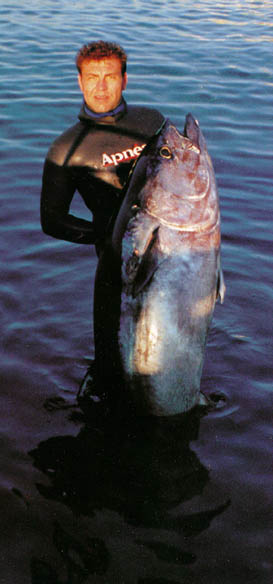
Notable catch for Atlantic Bluefin tuna, Giannis Margaritis—231 pounds (105
kilograms) by Giannis Margaritis as told to Terry Maas.
Bluewater hunter Giannis Margaritis stunned the Greek spearfishing community with the
105-kilogram (231-pound) bluefin tuna he speared in March 1995. Modern Greek divers,
hearing tales of giant tuna in their waters, longed for the chance to spear one. Acting on
the advice of a fisherman friend, Giannis traveled to a special spot off Corinthian Bay,
in 140 meters of water, where he cast bait-fish chum into the water as instructed by the
fishermen.
Two large bluefin tuna appeared, swimming up the baited trail. Ten meters deep, Giannis
aimed his pneumatic gun and shot the smaller of the pair; his 8-millimeter shaft scoring a
perfect hit on its lateral line. His detachable spearhead held fast as the mighty fish
pulled out 60 meters of line before it quite suddenly died. Ten minutes after his shot, a
proud Giannis hauled the big fish into his boat.
************************************************
|